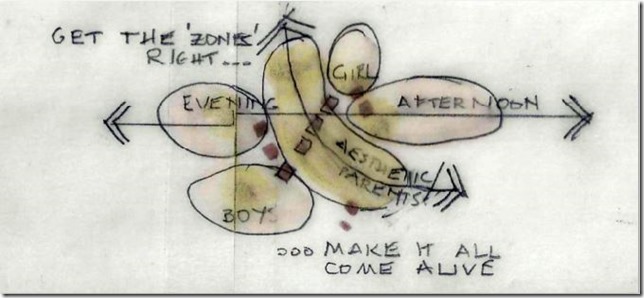
NB: This 3d hypermodel linked above uses Archicad BIMX technology. Click here for instructions to make your exploration of the model more enjoyable.
.

The Organon Architecture Blog

"The complete architect is master of the elements: earth, air, fire, light, and water. Space, motion, and gravitation are is palette: the sun his brush. His concern is the heart of humanity." ~ Frank Lloyd Wright, 1949[Hat tip to and photo from the Frank Lloyd Wright Foundation]
“It is almost possible to say that there is a mathematical relationship between the beauty of his surroundings and the activity of the child; he will make discoveries rather more voluntarily in a gracious setting than in an ugly one...”~ Dr Maria Montessori, founder of the Montessori educational system
.

There are several questions I get asked more than any other from clients, including "How much will this cost?", "When will my drawings be ready?", and "What's a ceiling deck?"
But if there's one question I get more than any other, it's "How long will council take to issue my building consent?" Which is also the most difficult question to answer.
You'd think it would be easy -- after all, the Building Act requires council by law to issue a building consent within 20 working days of the consent application being lodged. So does that provide a useful guide? Not at all.
You see, instead of applying their ingenuity to getting building consents out the door, overworked councils have instead devised many ingenious ways to get around this law that appears to hang a ticking clock around their heads. Most of them involve ways to stop that clock ticking.
Some councils, for example, will take a week or two to determine that your consent has indeed been formally lodged. Back in the days when we used to take hard copies into council offices, a meeting there would determine that you had indeed supplied all the necessary documentation, and the council's clock would then start ticking immediately. Today, it's different. First, the amount of paperwork we need to supply in lodging for a consent is a whole lot more than it ever was, so ti takes a whole lot longer to check it's all there. And because submissions are now online, it's up to council themselves to decide when the clock starts. Can you guess what sort of incentive they have to start that clock quickly?
So that's their first. It's annoying, especially when you're impatient to start. But it's nowhere near as maddening as what happens next.
Taking time to decide when your consent is lodged delays the clock starting. What happens next gives council a way to stop the clock ticking. What happens next is the result of another loophole in the Building Act -- that every time the council asks us for more information their clock stops again. And it doesn't start again until they have decided you've supplied what they're after!
Can you guess what incentives that sets up? Yes, you've guessed it: a huge incentive to ask any and every question they can dream up about extra information that for the most part is completely useless. "Please provide details of the stair fixing on the lower landing." "Please provide the make and model of the shower." "Please indicate the finish of the bathroom cabinet."
In recent months I've been asked about the colour of bedroom carpets (accompanied by a calculation to show they're bright enough); the normal process by which to pour a concrete footing in engineered soil (about which every apprentice could tell you); to abandon approved details because the territorial authority has decided they don't like them (replaced with those council themselves like but which look decidedly dodgy to me); the acoustics of polystyrene sheets (that are not being used for acoustic purposes); to resupply calculations and statements that the processor has already received, but lost; to explain why handrails are not required on steps with fewer than two treads; and how an opening window into an open lightwell allows light and air into a room; to draw up a list of a project's "construction and demolition hazards"; to provide mechanical ventilation rates for areas we've shown will use natural ventilation (i.e., windows); to draw up simple diagrams because processors are unable to read fairly standard plans; to confirm the use of smoke detectors (when they've already been clearly placed and labelled on drawings) -- just some examples of many, many, many recent Requests from processors, all of which have wasted my time and theirs, unnecessarily dragging out the consenting process, and all at the time and expense of clients who were once very eager to build.
The simplest RFI responses are to tell the questioner where precisely in the document set they can find the answer to their question, already addressed. And the stupidest I've ever received, "Please provide details of the basin splashback" -- this because the poor fellow couldn't find anything else in the drawing set about which to ask a question!
This is officially called a "Request for Further Information," or RFI, and they are the bane of every designer's and architect's life; instead of getting on with lodging our next job, we're instead answering stupid questions about our last one -- and all just to give our friends at council time to get on with what we'd all like them to be doing instead of writing letters to us!

So, how long does it all take then? Or, as my clients so frequently ask me: "How long will my building consent take?" The simplest answer is that it won't be 20 working days. Generally it's only at 19 working days that we receive our first RFI. Yes, I did once manage to get a drainage consent while I was standing there in the council offices. But that was many years ago. In general now, the easiest answer is to give clients a range: which is somewhere between six weeks and six months. The quickest I've seen one come out in recent years is 10 days. The longest was 10 months. (And the most maddening thing was that there was nothing substantially different about those two projects to justify that difference!)
So there's just no way to give a good answer, I'm afraid.
That said, it can be easier if council are processing over the Xmas break, because over the Xmas period there are very few official legally gazetted working days, so that council processors who are working through -- which can happen sometimes, when council are busy -- can actually process instead of delay. So sometimes it can make a difference getting lodged before Christmas.
And we do have to remember that we're building something for you to enjoy over many years. At the end of the day, when all the problems have been solved and your house is built and you're sitting there enjoying it all with your family, who really remembers an extra week or two at this point except those of us who have fought to get your paperwork over the line?
.

 |
| Floor Plan, Malcolm Willey house, 1933, by Frank Lloyd Wright (with then-radical integration of kitchen and living spaces highlighted) |
One of the things we hit upon was the quality of a host. That is, the role of the architect, or the designer, is that of a very good, thoughtful host, all of whose energy goes into trying to anticipate the needs of his guests—those who enter the building and use the objects in it. We decided that this was an essential ingredient in the design of a building or a useful object.I think that's a great way to think about it.
My partner, Lynette and I shared the mixed blessing of leading a design and branding firm for over 30 years. One of the lessons you take from that, is the understanding that the quality of your work is significantly determined by the quality of the clients you work with. Notice, I said work with, rather than work for. When a designer is able to ally as equal partner with a client of vision and courage, it creates fertile ground for optimal results in every endeavour. Doubtless, in our practice, our greatest achievements would not have been, were it not for the engagement, faith and occasional challenges presented by our clients.Applying this to Frank Lloyd Wright's highly innovative 1933 Willey House (plan, above), about which Sikora (as owner) writes frequently, not least about its dramatic impact on modern domestic design:
In the case of the Willey House, Nancy presented Wright with enough constructive resistance to lift her dance partner above the prevailing paradigms of domestic architecture.Wright's approach demands a demanding but open client.
As John Sergeant observed, “The relationship between client and architect was for Wright a thing of joint intent.” To achieve clear focus and gain permission, even “In large projects he always sought out one person and never a committee, to represent the client.” That, as they say, is easier said than done, but it was a prerequisite that governed his creative and persuasive processes...
When [his son] John Lloyd Wright considered a career in architecture, his father gave him this advice, “You’ve got to have guts to be an architect! People will come to you and tell you what they want, and you will have to give them what they need.” “Don’t you take the wants of the client into consideration?” John asked. “If you consider the house first, you will supply the needs of the client. The wants change from day to day, but a house must embody the needs of those who live in it. The architect must be aware of those needs, the client seldom is. An architect must have the courage to turn away a commission even if he is hungry if his work will not represent the highest ideals….Think it over, John: to be an architect is no light matter.”The Willey House was a small masterpiece that helped re-set Wright's residential thinking for the rest his career; a new form that flourished in the creative tension between a responsive architectural genius and a demanding yet sympathetic client.
Consider this, a client will typically select an architect based upon their past artistic expressions. Nancy Willey was certainly a case in point. Yet the same client will judge their architect by how well their needs are met, once the design is implemented. This too, is evident in the correspondence between Nancy Willey and Frank Lloyd Wright. In her initial letter she asked “What do you think are the chances of my being able to have a – creation of art?” She repeatedly expressed wanting to follow his instructions to the letter. But when pressed into a corner, having to decide between high art and pragmatism, she was willing to fight for what she knew she needed and could afford. On November 17, 1933 frustrated with construction bids coming in at two times over budget on scheme 1, she penned a terse letter to Wright. In it she wrote, “I do not want a seventeen thousand dollar house even at twelve or ten thousand dollars. I want an eight to ten thousand dollar house at eight to ten thousand dollars. Can I have it?” We have Nancy’s red line and assertive pushback to thank, for what inspired Wright to cast aside his initial ideas and ultimately seek a more appropriate solution. Once the water broke, something new and wonderful was born, relieving the tension between clients and architect. From that point forward, in full alignment, both parties strove to advance the project with renewed enthusiasm. In Nancy’s own words from her Oral History interview with Indira Berndtson “…and how he responded, once he accepted it!!Dance partners -- host and guest -- interpreter of true needs -- discover of a client's inner person. The good architect is all of these in one. And the ideal client is the ideal reciprocal to all these. But as Steve Sikora summarises, there is one quality above all that is required of a good client:
I had the chance to meet a life-long graphic design hero of mine, Milton Glaser. It was at a conference in New Orleans, where we both presented. An idea from his presentation became indelibly inscribed into my memory. While discussing his long career, Milton spoke about clients. He said, “I could never work for anyone who I did not have a genuine affection for.” His words were profound, because they implied two things; he could only do his best work for people he liked, but also, in a professional context, he gave permission for designers to understand, appreciate and embrace clients as fellow humans, even potential friends. He believed in collapsing formal, professional barriers. I instantly related his sentiment to my own client relationships.And I, I hope, to mine.

“Man takes a positive hand in creation whenever he puts a building upon the earth beneath the sun. If he has any birthright at all, it must consist in this, that he, too, is no less a feature of the landscape than the rocks, trees, bears or bees of that nature to which he owes his being.”
~ Frank Lloyd Wright, 1937


Fire engineers are accusing councils of making illegal demands on them that are inflating building costs by thousands of dollars... "I've become totally used to how bad it is, I'm sort of numb to it, it's just a bureaucratic nightmare right now," Wellington fire engineer Kenneth Crawford of Pacific Consultants said. "We've got so many demands coming from council ... it's pushed up costs, it's creating months and months of delays in obtaining a building consent, and none of this is actually really improving safety." A fire design on a small warehouse in 2013 that might have cost $1200 to $1500 was now costing at least $4000, and up to $20,000, he said.Sadly, as anyone who's recently endured the consent process could tell you, it's not confined to fire engineers.
 I'm sure you can all add your own list of examples. (And please do!)
The impact of everyone trying to pass all the risk on, was it was getting harder to build anything at a time of housing shortages, the Property Council's chief executive Connal Townsend said..
"The overall public policy setting of how the heck we manage risk, is completely out of whack," he said.
"We've just got people passing the ticking timebomb from one hand to another and blaming each other. It's pointless.
"We have to tackle the way risk is allocated and the fact that councils are left carrying the liability is just hopeless, absolutely hopeless."
The previous government tried hard to fix the problem [cough, cough - Ed.] but couldn't, and it was urgent this government confront it, he said.
The risk issue was a perverse result of building laws being overhauled in 2004 to combat the leaky building crisis.
Lawyers, including the Law Commission in a 2014 report, have since then resisted changing the way liability is doled out.
"The net effect of our joint-and-several system is that councils are left carrying the can," Mr Townsend said.
"This story with the fire engineers, all they've done is blown the whistle on a ridiculous problem that has to be solved."
His reassessment is long overdue.The beautifully-photographed book is self-published by UK-based architect Giles Reid, with generous backing from the Warren Trust. So here's your reminder that the last recommended posting date from the UK for Christmas delivery is Saturday 9th December.
http://www.counterconstructions.com/I hope you will take a look.


"[Louis] Sullivan’s ornament never feels as though it is imposed from without. It does not feel applied. Instead, his ornament really does manifest what 'organic' is actually supposed to feel like, 'as though the outworking of some beneficent agency had come forth from the very substance of the material and was there by the same right that a flower appears amid the leaves of its parent plant.'”
~ Barbara Lamprecht, from Part IV of her book/article 'Why It's Okay To Like Ornament,' quoting Michael Lewis

"This greatest feature of [Louis Sullivan's] work was esoteric. Is it any the less precious for that?
"Do you realise that here, in his own way, is no body of culture evolving through centuries of time but a scheme and 'style' of plastic expression which an individual working away in this poetry-crushing environment ... had made out of himself? Here was a sentient individual who evoked the goddess whole civilisations strove in vain for centuries to win, and wooed her with this charming interior smile -- all on his own, in one lifetime too brief. ... Although seeming at time a nature-ism (his danger), the idea is there: of the thing not on it; and therefore Sullivanian self-expression contained the elements and prophesied organic architecture. To look down on such efflorescence as mere 'ornament' is disgraceful ignorance. We do so because we have only known ornament as self-indulgent excrescence ignorantly applied to some surface as a mere prettification. But with the master [Sullivan], 'ornament' was like music; a matter of the soul..."
~ Frank Lloyd Wright writing in his book Genius and the Mobocracy about the only man he ever called his Master


I came to realise after many years … a pinch-me realisation, that after many years there had not been a single day of my life, even the bad days that happen in every life, where I was not aware of seeing something beautiful. I always, every day of my life, [am saying] ‘isn’t that lovely’ — whether it’s … in the morning I look up and see the way the wood is mitred in certain places, and how it contrasts with the light through the window which is either nice and green fro the trees or white with snow; and I could go on with similar awareness. “We sit outside (in summer-time) … and look around and say ‘isn’t it beautiful!,’ ‘isn’t it wonderful!’ — every day, every time…Not a trivial point.
Neuroscientists have observed … that living with a sense of awareness of beauty brings a sense of comfort, a reduction of stress, and these other kinds of things, that may contribute to physical and emotional health, possibly even longevity. I’m 93 years old! I’m in very good shape for 93 years old. I like to attribute that to this sense of beauty that I’ve lived in all my life.
It also has made me very conscious, as I talk about this house and the architecture and how it makes me feel, of the importance of the built environment generally. “I remark these days not just to visitors but to architects as well: ’You know, these buildings are just objects. We may like how they look, we may not like how they look, but what matters is how they make us feel. When we’re in this environment, does it feel good, does it [make us] feel better, does it feel enriching. And that may or may not coincide with whether we like the way it looks. I think Wright understood that, and he created environments in which people feel good.


"Organic architecture is an architecture from within outwards — in which entity is the ideal. … Organic means, in a philosophic sense, entity. Where the whole is to the part and the part is to the whole. Where the nature of the materials, the nature of the purpose, the nature of the entire performance becomes a necessity and out of that comes what significance you can give the building as a creative artist."
~ Frank Lloyd Wright, from his interview (above) with Hugh Downs.
 |
| Burridge-Read Residence designed by architect David Boyle |
“People say ‘location, location, location.’ They never say ‘design, design, design.’ I finally got why architects spend as long as doctors getting an education. They do something really magical. They don’t save lives but they enhance them.”
~ Tim Read, owner of the Burridge-Read Residence (above), quoted in the article 'Selling architect-designed homes: real estate agency that markets on architectural merit not location'.
"Paul Newman will have some time in jail to read up about architecture. Maybe he can even study for his exam and, no doubt, pass it. He could even emerge as a good contributor to the discipline and the profession. But what worries me more than the presence of a few shady and crafty operators such as Newman is bad architects who, under the cloak of licensure (and without the [architects institute] or anybody else able to do anything about it), commit crimes against our landscapes and lives on a daily basis. Those are the ones that should really go to jail."
~ Aaron Betsky, dean at the Frank Lloyd Wright School of Architecture at Taliesin and Taliesin West, on the jailing for seven years of a man for practising architecture without the state's license.

The wonderful kitchen designer with whom I often work, Leonie Von Sturmer, is far better at self-promotion than I am — and here (above) on the front cover of the latest Trends magazine is the new house and kitchen we recently worked on at Greenwood’s Corner, Auckland.
With its new roof carefully located to manouvre through council’s height-in-relation-to-boundary controls, I love the way you can relax at the kitchen counter with a beer, enjoying the birdlife and foliage of the surrounding trees through the glassed gables and dormers.
(If I say so myself), it makes for a surprisingly open and informal setting in a relatively constrained site.
.


Frank Lloyd Wright was one of the most prolific and renowned architects of the 20th century, a radical designer and intellectual who embraced new technologies and materials, pioneered do-it-yourself construction systems as well as avant-garde experimentation, and advanced original theories with regards to nature, urban planning, and social politics. Marking the 150th anniversary of the American architect’s birth on June 8, 1867, MoMA presents Frank Lloyd Wright at 150: Unpacking the Archive, a major exhibition that critically engages his multifaceted practice. The exhibition comprises approximately 450 works made from the 1890s through the 1950s, including architectural drawings, models, building fragments, films, television broadcasts, print media, furniture, tableware, textiles, paintings, photographs, and scrapbooks, along with a number of works that have rarely or never been publicly exhibited. Structured as an anthology rather than a comprehensive, monographic presentation of Wright’s work, the exhibition is divided into 12 sections, each of which investigates a key object or cluster of objects from the Frank Lloyd Wright Foundation Archives, interpreting and contextualising it, and juxtaposing it with other works from the Archives, from MoMA, or from outside collections. The exhibition seeks to open up Wright’s work to critical inquiry and debate, and to introduce experts and general audiences alike to new angles and interpretations of this extraordinary architect.
Among the many projects currently in the office is this one, a renovation of a mid-century modern in Howick, offering opportunities to rethink New Zealand’s modernist heritage, and to undo some of the later “modernisations.” And, like every renovation project, it involves a bit of untangling …

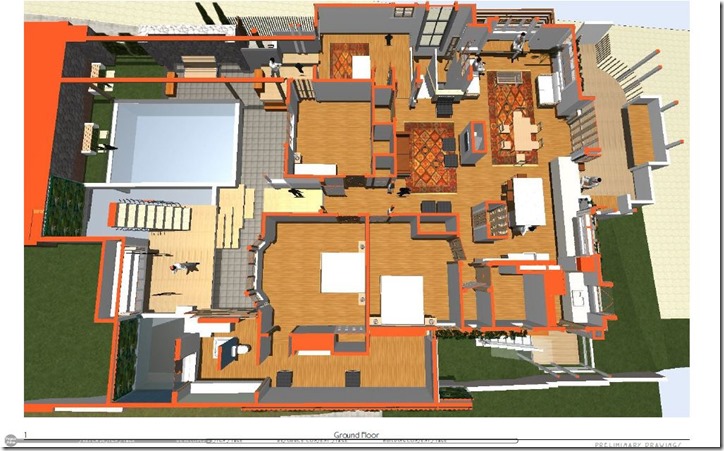


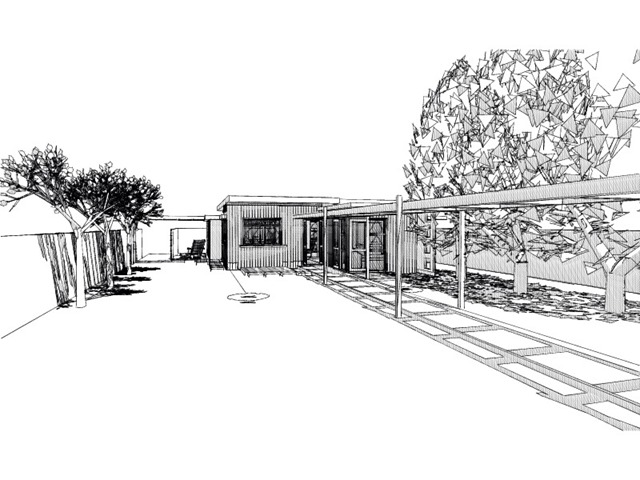


Designing a house form that works and that can be replicated to produce variety is fun, and economical, but not straightforward.
This project, by Organon Architecture, has 36 houses of two types; two types whose lower floors are identical and whose upper floors differ only in their orientation – and in that difference lies the difference that produces the difference: two house types in which the way they come together creates the structure of the composition, produces the interest, creates (with the simple form becoming complex by repetition and the relationship to the other repeated units) creating the relationship of composition to landscape.
Repetition means ease of assembly. Repetition means making use of industrialisation to reduce costs and waste. Repetition, here, producing variety instead of conformity.
That’s they way nature does it. That’s the way to make it work.
I think it does.
Could you live here?